$30 billion mega gas project set to enrich Australia’s countrywide GDP by $98.7 billion
What happened
Woodside has advanced a large Browse-to-North West Shelf gas development concept and is progressing activities toward FEED entry. The programme is large, offshore and long‑horizon, which makes it a material demand signal for vessels, ROVs, umbilicals and long‑lead equipment that serve Australian offshore projects. Watch whether FEED milestones trigger firm orders for long‑lead items and local mobilisation bookings
Buyer takeaway
Treat the Browse FEED signal as a structural demand shift for APAC offshore assets because large upstream programmes compete for the same mobilisation, specialist crews and long‑lead equipment used in P&A
Cost / money
Directional upward pressure on mobilisation and long‑lead pricing as larger programmes absorb local vessel and equipment capacity
Supplier / commercial
Suppliers supporting large projects will prioritise long‑term commitments, shortening quote windows and inserting slot clauses in tenders
Safety / operations
Higher activity and concurrent campaigns increase vessel traffic and seabed interaction risk unless exclusion and coordination windows are enforced contractually
What to watch
Watch for FEED milestones that convert concept work into firm long‑lead orders or bookings that reduce redeployable capacity
Key facts
- Project in concept definition with progress toward FEED entry
- Capital expenditure described as multi‑billion and long‑horizon
- Located almost 300 km offshore in deep water
Source excerpts
8 billion ($13
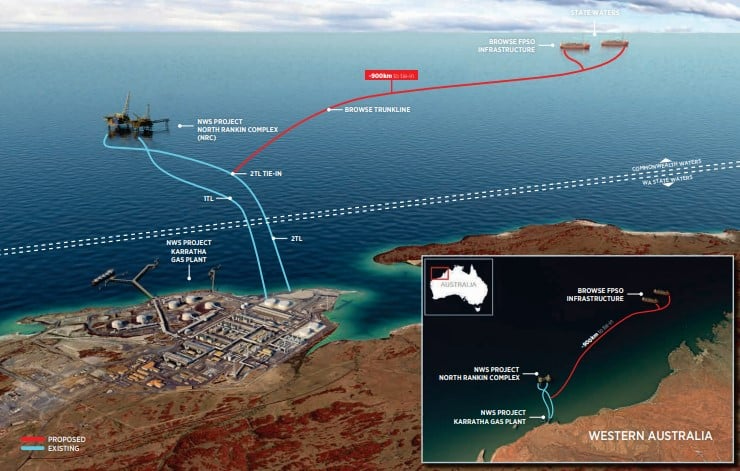
Browse to North-West Shelf project development concept; Source: Woodside After Woodside obtained environmental approval for the North West Shelf (NWS) project extension from the Western Australian government, restarting the federal environmental approvals process, the green light was perceived to be the key to advancing the firm’s Browse gas project and extending the Karratha gas plant’s life to 2070. This project is currently in the concept definition phase, and key activities continue in support of progress
Given that around 80% of economic impacts are expected to flow to industries outside oil and gas, including construction, services, and public services, the findings indicate Australian communities, businesses, and public services are expected to benefit if the Browse to NWS project is developed